Muir Woods
Please leave this field empty
 

MAY PARK E-VENTURES

CRISSY FIELD... BEFORE & AFTER & FOREVER

Before
Crissy Field, originally a salt marsh rife with wildlife, was filled in to serve as a grand-prix racetrack in 1912 as part of preparations for the 1915 Panama-Pacific International Exposition. It later became an airfield that saw pioneering feats by early aviators from 1920-1936. As its use as an Army airfield waned, the parcel fell into neglect.

Then the Evelyn and Walter Haas, Jr. Fund intervened. The late Walter Haas Jr., who was an avid outdoorsman, saw the potential for a great park amid the chain-link fences, torn-up asphalt, and scraps of old tires. In 1986, his family foundation funded a study to look at the feasibility of creating a place to be enjoyed by all.

Spurred by the Haas, Jr. Fund’s historic lead gift and energized by the Parks Conservancy’s “Help Grow Crissy Field” campaign, the entire community rallied to the cause. Thousands of donations poured in and more than $34.4 million was raised. Over 3,000 volunteers rolled up their sleeves to help plant 100,000 plants. And then, after three years of working side-by-side, the community came together on May 6, 2001 to celebrate its shared achievement.

After
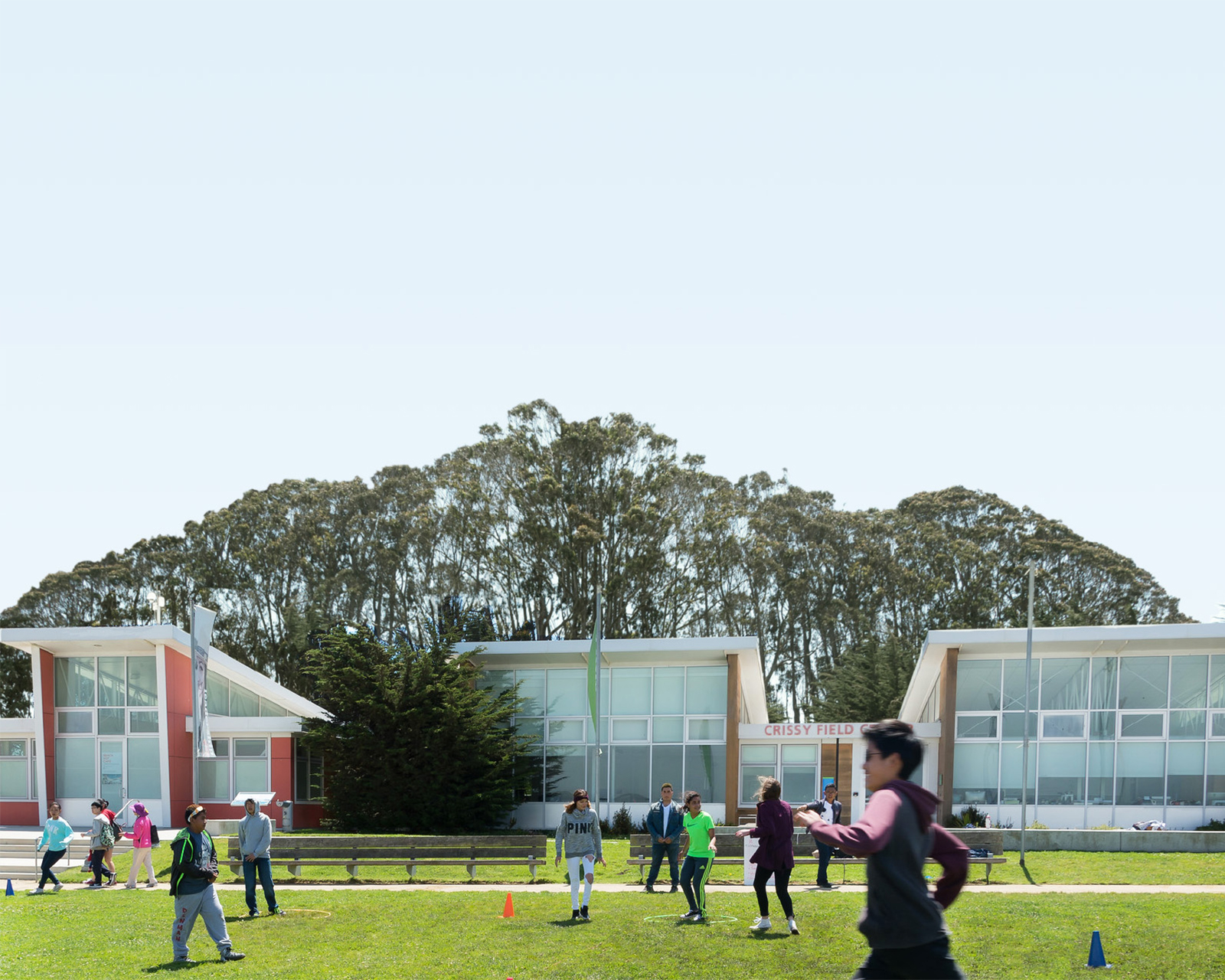
What we celebrated on that May day was astounding. After 70 acres of asphalt and concrete had been crushed and reused, 87,000 tons of hazardous material removed, and 130,000 plugs of salt grass planted by hand, we had created a gorgeous 100-acre swath of national parkland— including a restored grassy field, revitalized marsh, new shoreline promenade, and an environmental education facility, the Crissy Field Center, to ensure our stewardship of the land endures in future generations.

While the physical transformation of the place was dramatic, Crissy Field’s real impact was felt in the hearts and memories of all who have come to enjoy its beauty. As part of our 10th anniversary commemoration, we are collecting stories from community members about the wonderful and poignant memories they’ve experienced at Crissy Field. Our friends and neighbors have marked milestones in life there—passing the bar, celebrating a birthday, getting engaged, sharing first walks with newborns, and saying good-bye to loved ones—all by the waves of the Bay. Read their stories, and share your own... leave a Valentine to this park we’ve “grown” to love.

Forever
Let’s ensure Crissy Field continues to be a park for all forever. Consider making a gift to this special place. Or come volunteer at Crissy Field, in the Presidio, and throughout the Golden Gate National Parks. The same spirit that created Crissy Field is what inspires us in everything we do here at the Parks Conservancy. Thank you so much for giving the community this gift.

- back to top -

TEN YEARS OF IMPACT:
ONE YOUNG LEADER’S PERSPECTIVE

In 2001, Crissy Field Center began a remarkable journey to bring urban communities in closer contact with their Golden Gate National Parks. Our goal was simple—to offer relevant, multicultural environmental education that would inspire youth to take an active role in making positive change in the national parks and in their communities.  

A partnership program of the Parks Conservancy, National Park Service, and the Presidio Trust, the Center has become an innovative model for youth engagement initiatives around the world. From the Center’s opening in 2001 through May 8, 2011, Crissy Field Center has:

  • Provided 1,333,671 hours of programming to 588,058 children, youth, and families
  • Served students from every public middle and high school in San Francisco Served students from 67 out of the 72 public elementary schools in San Francisco
  • Provided 370 green jobs to youth (ages 15 to 25), who have become teachers, policy advocates, restoration ecologists, education coordinators, and community organizers
  • Provided over $256,000 in transportation scholarships to schools and community groups
  • Partnered with over 100 youth-serving community organizations to reach young people who traditionally have had little opportunity to experience national parks


One of our very own staff made his start at the Crissy Field Center as a 16 year old helping to create a new national park site and “Grow Crissy Field.” Sam Tran, Crissy Field Center’s youth program coordinator, has been with the Center for 10 years and there’s little doubt that he—and the Center—have been transformed by the experience.

What was the first experience you had at Crissy Field?
      
I did my first restoration project at Crissy Field and was able to help “grow Crissy Field.”  I remember planting a lot of native plants, especially the sticky money flower by the marsh.
            
What made you want to continue your involvement?

It was the ladder of opportunities the Center had to offer me when I graduated from high school. After graduating from high school I had a summer job opportunity to be a Junior Ranger Instructor, which led to being the Center’s Summer Camp Instructor, then the After-school Junior Ecologist Instructor, and now the Urban Trailblazers’ Instructor. I was very blessed that I was able to have these opportunities as a young adult.

Why did you want to work here?

I wanted to work at the Crissy Field Center because the enter really walked their talk, based on their mission statement—to ”encourage new generations to become bold leaders for thriving parks, healthy communities, and more environmentally just society,” I believe the Center did a remarkable job in really investing their time and resources with the youth they worked with. I really admired the staff for their commitment to the youth. I came back because I wanted to replicate the experience I had as a high schooler, with the youth I work with now. I also value how the Center is always so innovative with their programs; everyone is very supportive when there’s a new idea to make a program more successful and fun.

How have you grown because of Crissy Field Center?

I have become more aware and sensitive when working with underserved kids.  I am more conscious of where they come from—their lifestyles, neighborhoods, and culture. Gaining this new perspective has helped me deliver programming that is more multicultural and more relevant and meaningful to the youth.

What’s your fondest memory?

My fondest memory at the Crissy Field Center was when I had the chance to take 12 middle school summer campers for a three-day backpacking trip to Point Reyes National Seashore. I can still picture those summer campers carrying backpacks that were as big as they were. We hiked about 8-10 miles for the first day, set up camp, ate dinner, went to bed only to wake up and continue with our next hike, which was as long as the first one. This was the most extreme backpacking trip I have ever been on, especially with youth. I wanted to give them the best experience and optimize their learning potential, and make sure they were not bored. I even went as far as pretending to eat “coyote scat”—which was really a rolled up Powerbar!

What are your hopes for the future?

My hopes for the future at the Crissy Field Center involve us going to conferences either globally or nationally and making a positive impact with people we meet. I would love to see other programs follow in our footsteps with their youth engagement programs. I would like to see our youth program model expand to other cities and states.
 
What are you most excited about?

Late last year I had the opportunity to attend a nationwide conference in Indianapolis of the National Summer Learning Association. I was able to meet a lot of passionate and excited people who shared the same frame of mind and goal in trying to find ways to improve their summer programming. In the coming years, my goal is to consistently improve our programs so that they are recognized at this conference and at the national level.

- back to top -

RAPTOR NESTS IN OUR PARKS:
BUTEOS AND FALCONS

By Allen Fish, GGRO Director

Raptor Nest

Raptor nesting is a dicey game. It is a balancing act of evolution and opportunity, of raptorial life experience and adaptability to the pressures of its neighborhood. Each species of hawk, falcon, eagle, and kite has its own signature nesting technique, and its own means of keeping alive its eggs, chicks, and naïve fledglings for the three-plus months needed for them to become independent. 

Think about the daunting challenges. Raptors must keep their eggs warm and unbroken. They must keep their chicks protected from overexposure from rain or sun. They must dodge Great Horned Owls at dusk, cunning Ravens, sharp-smelling raccoons, and habitat-changing humans—all nest predators. Other threats to nesting raptors: back-to-back days of wind, tree trimmers, rat-poisons, and if you’re a ground-nesting Northern Harrier, all mowing equipment.

Most of our hawks are tree-nesters. They find a suitable tree and make many trips to build a nest from scratch or re-structure an existing nest. In spite of how well-studied birds are, nest site selection is still a pretty mysterious endeavor. For some species, like Red-tailed Hawks, the neighborhood seems to be more important than the tree type. Locally, Redtails seem to prefer nesting in large trees at the edge of an expansive, hunt-able grassland. They are more likely to build a nest in a tree on the lee side of the grove, and with the nest against the main trunk.

As far as nest trees go, Redtails like the tall ones, which seem to have multiple advantages: (1) a big tree can support a big nest; (2) a high nest is better protected from climbing predators (raccoon and grey fox); and (3) a hawk can see a long way out from a tall nest platform. Redtails also seem to like a loose canopy that they can fly in and out of quickly. Around here, a preferred nest tree can mean a blue gum eucalyptus, Monterey pine or cypress, valley oak, a California sycamore, Fremont’s cottonwood, or Douglas fir.

Red-shouldered Hawks make a similar nest in a tree, although instead of building a big Redtail-sized stick nest, they make a smaller stick nest usually near the main trunk. Where Redtails prefer being on the lee-side of a grove facing open space, Redshoulders nest inside the grove.  Being smaller birds, Redshoulders tend to fly and even hunt inside the tree canopy.

Both Redtails and Redshoulders regularly trade nests with Great Horned Owls and even with Ravens. This behavior happens largely because owls do not build their own nests, so a vigilant Great Horned Owl is often seeking out empty stick nests as early as December. (Okay, so “trade” is not quite the right verb. More like “steal.”) This is one way to get a jump on the nesting hawks, although someone told me recently about a Great Horned pair chasing a Redshoulder pair on eggs out of a nest in late March. Ravens do build their own stick nests but, like hawks, sometimes build directly on top of an old hawk nest.

Falcons, like owls, also are not nest builders. They procure nests (some would say steal), but it really depends on the species. Our big Peregrine Falcons are likely to find an aerie, literally a “hole in a wall” on a cliff face near the Pacific Ocean. But in recent decades, these speed-demon, bird-eating falcons have discovered that bridges and buildings are decent substitutes for a cliffs.  The big flaw in this logic: plate-glass windows. For the parents of a newly fledged falcon chick, large windows—and falling into traffic or San Francisco Bay—can mean the difference between a successful nesting season or a failed one.

Finally, our other local falcon is the miniature, but oh-so-testy American Kestrel. Robin-sized, and as much insect-eater as meat-eater, the American Kestrel is one of the smallest kestrel species in the world. And its perfect home? A hole in an old tree. In lieu of a natural tree cavity, a nestbox or simply a hole in a building will do. In a pinch, they will use a pile of rocks.

Since the kestrel cannot excavate its own hole, it counts on some other species—a large  woodpecker, Northern Flickers, Hairy or Pileated Woodpeckers—to do the hard work in chiseling out an access hole by boring through the hard outer layer of an old tree. The Kestrel’s problem is out-competing bluebirds, starlings, small owls, chickadees—all the non-excavating cavity-craving birds that may ALSO want that hole. And sometimes, the spoils go to the smaller species.

High rent and through-the-roof price tags—even the raptors run into them here in the Bay Area.

Next Month: Where do all those Turkey Vultures nest?

- back to top -

INSTITUTE LAUNCHES FOOD FOR THE PARKS REPORT

Food for Parks Report

The director of the National Park Service, Jon Jarvis, officially launched the Institute’s Food for the Parks initiative by announcing his support at the Healthy Parks Healthy People US forum on April 5-6 at Fort Baker.

Jarvis gathered more than 100 leaders in health care, the environment, nonprofits, government, and business to grow the connections between public lands and public health. At the conference, Director Jarvis announced a commitment to implement a NPS-wide “Healthy Foods Strategy.”

This approach aligns with the Institute’s work on the new  Food for the Parks Report: Case Studies of Sustainable Food in America’s Most Treasured Places. The publication, released in conjunction with the Healthy Parks Healthy People movement, will be a resource for concessionaires, park leaders, and food providers to find ways to offer healthier, local, and more sustainable food choices in national parks in the U.S. and around the world.

The Institute’s  Park Prescriptions Report: Profiles and Resources for Good Health from the Great Outdoors, which was created in support of the President Obama’s Let’s Move Outside initiative, is another example of a key resource helping to drive this movement forward.

For more information about the Food for the Parks initiative and to download the report, visit www.instituteatgoldengate.org/foodfortheparks. For more information about the NPS Healthy Parks Healthy People US movement, visit http://www.nps.gov/public_health/hp/hphp.htm. Follow the Institute on Facebook and Twitter to keep up-to-date on the latest developments and learn how you can help support the initiatives.

- back to top -

TIME TRAVEL: RARE PHOTOS
OFFER PEEK AT PARKS’ PAST

Natural History Photo Collection by Greg Gaar
In May, we celebrate the 10th anniversary of Crissy Field’s community-led transformation. It’s worth stopping to reflect on how our restoration efforts have changed landscapes all across our Golden Gate National Parks. Thousands of plants—planted by thousands of volunteers—have helped restore park sites such as Crissy Field. There, the restored grassy airfield provides a beautiful oasis of open space for the surrounding community, while the tidal marsh, with its abundant maturing coastal scrub plants, serves as a serene habitat for local wildlife to forage and nest. Looking back at old pictures of the area, it’s hard to imagine our beloved Crissy looking any other way.  

Historic Marina Watershed, Photo from the Greg Gaar Collection
How have other natural landscapes in San Francisco evolved over time? For a visually dramatic answer, Park Academy (one of the many educational programs offered at Golden Gate) is hosting A Natural History Slideshow of San Francisco with Greg Gaar.

Mr. Gaar has spent much of his life helping to preserve the City’s native landscapes—the landscapes he remembers as a child—and collecting and preserving an “awe-inspiring” collection of historical images that chronicle San Francisco’s natural history. Born in San Francisco in 1948, he started collecting photographs of the City as a child. His images depict the large dunescapes that once covered much of the coastline, as well as tidal marshes and coastal prairies.

This extraordinary opportunity to see San Francisco (as it once was!) will proudly be hosted at 2 pm on Tuesday May 10, at Building 201 Fort Mason. All are encouraged and welcomed to come. For more details, click here.  

Park Academy is an educational program offered through the Golden Gate National Parks Conservancy as a way to enrich the volunteer/member experience, as well as provide staff development for incoming employees and volunteers. Started to support the professional training of our park interns, the program began with a focus on natural resource and nursery-related topics in the beginning. However, it has quickly grown to incorporate a wider variety of topics related to our parks. For more information about Park Academy, including a list of upcoming classes, please visit our webpage. If you would like to be on the mailing list for the monthly announcement of upcoming classes please e-mail cvoigt@parksconservancy.org.

- back to top -

PARK PIC OF THE MONTH
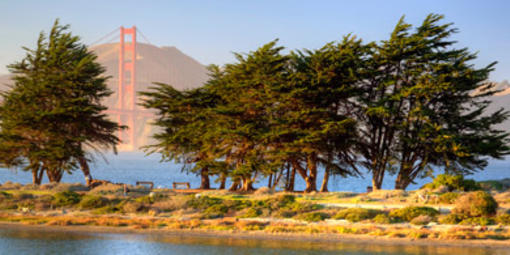
Crissy Field, Photo by Sean Foster

Watching the time go by at Crissy Field, photo by Sean Foster.

-See more photos-

- back to top -

THE GRAND WALK IN SAN FRANCISCO

The Grand Walk

One of the most scenic and stunning trails in the West can be traversed without leaving San Francisco. This six-mile “Grand Walk,” paralleling the coastline from the Cliff House to Fort Mason, is like a perfect geographical jigsaw puzzle; it pieces together the jutting cliffs of Lands End, the sands of Baker Beach, and the rugged boulders north of Battery Crosby.

Start this city adventure by taking a bus to the Cliff House. From there follow the Coastal Trail through Lands End as the Golden Gate Bridge comes into view, arcing like the North Star in the background and remaining visible during almost the entire trip. This portion of the route finishes in the swanky Sea Cliff zip code. Walk the residential sidewalks and take a little-known backdoor route to Baker Beach (described in the directions below). Continue along the beach to the toughest part, a 243-step sand ladder. Red-tail hawks are the hang-gliders of these dunes, so keep an eye out.

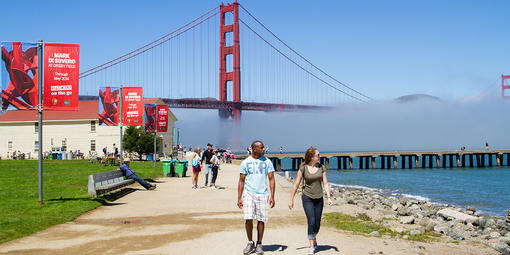
Next up is the recently renewed Batteries-to-Bluffs Trail (pictured) and spectacular Battery Crosby. Go down the wooden stairs just past the battery and be sure to check out Marshall's Beach—a mini Baker Beach that’s a good stop-and-snack destination. The trail climbs back up to the Golden Gate Bridge. Brace yourself for the surge of tourists there, and take a moment to see if there are any surfers braving Fort Point beneath the Golden Gate. Then follow the path that dips to Crissy Field and the Marina Green. Savor the last few steps as you arrive at Fort Mason. Urban mission accomplished.

BONUS: At Fort Mason, refuel at Greens Restaurant (Parks Conservancy members receive 15 percent off with your Parks Conservancy membership card. Offer applies for lunch Tuesday through Friday and dinner Monday through Friday). Grab a window table and replay your “Grand Walk” highlights over bay views.

From the Cliff House walk up Point Lobos Ave. and take a left on 48th Ave. to jump on the Coastal Trail in Lands End. This ends in the Sea Cliff neighborhood. Walk along El Camino del Mar, then continue on Seacliff Rd. (don’t follow the first “public beach” signs). Make a left at 25th Ave. North; at the dead end, walk through the gate to Baker Beach. At the far east end of the beach, walk up the sand ladder. Continue on a trail beside Lincoln Ave. Turn left at the Batteries to Bluffs Trail toward Battery Crosby. There might be detours with well-marked signs along this portion of the trail heading toward the Golden Gate Bridge. Cross under the bridge through a pedestrian and auto tunnel below the toll booths. Pop out the other side and follow the trail along the waterfront all the way to Fort Mason.

Weekend Sherpa Logo

For more adventures like this one, sign up for Weekend Sherpa’s free weekly e-mail of fun and exciting excursions!


- back to top -

A 130-MILLION-YEAR STORY OF SEDUCTION

By Price Sheppy

Missionbells Fritillaria affinis

Flowers and flower designs are so ubiquitous in our culture that they are easy to overlook. But if you take a moment you will notice that flowers are honored everywhere—on fabrics, tattoos, and cards using flower designs. And what would Valentine’s Day or a wedding be without flowers?

And while flowers certainly have humankind’s attention, their crazy colors and shapes were originally designed to attract their pollinators. There are many flower pollinators (12 different types of bees alone, just in the Presidio!). There are also hummingbirds, moths, beetles, moths, and flies that pollinate as well.

Flowers use different timing mechanisms as part of their strategy to attract pollinators. Some flowers start blooming early to beat the rush; if they can open the earliest then the pollinators—hungry after a long winter— will have no choice but to go to them. Other plants wait and bloom when conditions are ideal, but then have to compete for the pollinator’s attention by creating showier flowers then their neighbors. Other flowers are in it for the long haul and create many flowers that open at different times to attract pollinators over an extended period of time; they are hedging their bets. Some plants are also choosy about the time of day. The wavy leaf soap plant, which has a long stem of flowers that open one at a time, opens its flowers in the evening to be pollinated by the night time flyers—moths.

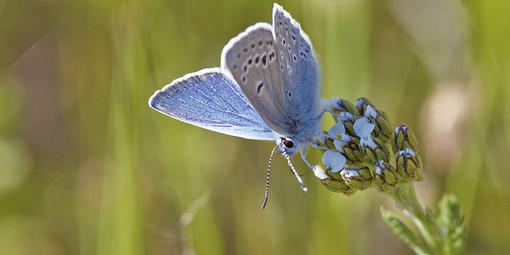
The designs of plants and flowers also play a role in luring a potential pollinator. The yarrow plant has many white flowers that create a landing pad for butterflies to use. Other plants like bee plant, mission bells, and seep monkey flower create unique flowers that cause the bees to crawl in—forcing them to get the nectar in such a way that the flower will always be pollinated. Other plants like the hummingbird sage and California fuchsias have long, pitcher-shaped flowers that are perfect for hummingbirds to pollinate.
 
This relationship between plants and pollinators started 130 million years ago—during the waning years of the dinosaurs and when the first birds took to the sky. During that time there was pollen—but no flowers—and beetles would fly from plant to plant eating pollen. It took just a little adaptation and some time to get the beetles to work for the plants instead of against them. (That ancient relationship between plant and beetle still exists today in the magnolia tree, which produces an overabundance of pollen to attract pollen-eating beetles.)

As time passed flowers adapted new ways of attracting different pollinators with nectar, showy petals, and wonderful smells. Now there are many pollinators across the world today, and it isn’t just insects that are attracted to flowers anymore.

On your next walk down the street or out to the parks, take time to count how many different flowers you see. You will be surprised about how many you encounter. Take the time to smell them, and try to figure out their strategies for attracting pollinators. Allow yourself to be seduced by a cross-species seduction that has been going on for millions of years. And while the flowers’ relationship with pollinators has allowed them to thrive for 130 million years, it might be their ongoing relationship with humans that allows them to continue thriving for the next 130 million years.

- back to top -

SEE THE LOOKOUT'S BEGINNING AT LANDS END

Lands End

Construction of the new visitor facility at Lands End—the Lookout—begins May 23! Join in a community celebration as we prepare to break ground on May (17, 18, or 19) at 5:30 pm. Thanks to the Richard and Rhoda Goldman Fund, the Horace W. Goldsmith Foundation, and input and support from the community, the dream of a visitor center at Lands End is that much closer to reality.

- back to top -

VOLUNTEER HIGHLIGHT: A CRISSY STEWARD FROM THE START

Volunteers Sharon, Sue, and Vicky at Crissy Field

As we celebrate the 10th anniversary of the transformation of Crissy Field, the milestone is especially meaningful to San Francisco native Sharon Tsiu. Among the thousands of neighbors and park friends who have given their time and energy to grow Crissy Field, Sharon, it turns out, might have been one of the very first volunteers.
 
“The restoration of Crissy Field was a project just too exciting to resist,” Sharon says.
 
In 1997, Sharon joined an AmeriCorps effort to work on Crissy Field. Her involvement grew from there—participating in the creation and upkeep of the shoreline national park through the Crissy Field Stewards program (which later merged with the Presidio Park Stewards) and becoming a Parks Conservancy member in 2002.
 
Over the years, Sharon has clocked more than 1,000 hours of service at Crissy Field. And for all that planting, seed-sowing, invasive weed pulling, sand shoveling, hummock building, fence mending, and garbage collecting, the reward is feeling the pride in building a national treasure.
 
“Just seeing and participating in the transformation of Crissy Field—from a parking lot to a gigantic pit to dunes and marsh—has been gratifying,” Sharon says. “It isn’t very often that one gets to transform a place, especially into someplace that just about everyone seems to like!”
 
A big reason why Sharon has been a volunteer for so long is the quality of the people she works with—the dedicated community members who have become fast friends. “The best part of being a volunteer is sharing similar goals with a great bunch of people—from volunteers, to staff, to interns.”
 
Another key individual who has contributed to the restoration of Crissy Field is Michael Chassé, who first got involved as an intern with the National Park Service in 1996. Now he’s helping lead the ongoing stewardship of Crissy Field, as an NPS natural resource management specialist. He recognizes that growing a dedicated group of volunteers is crucial to long-term success.
 
“Volunteer stewardship has been as much about building community as it is about restoring nature,” Michael says.
 
For those who would like to join their ranks, Sharon recommends checking out the regular drop-in programs, during which there are a great variety of activities to try out (visit www.parksconservancy.org/volunteer). But whatever you decide to do, Sharon believes your effort will be worth it.
 
“Too often, people don’t take action because issues seem too big and they don’t know where to start,” Sharon says. “But with a motivated group of people, it’s possible to take direct action to improve a small part of our world.”
 
A staggering 65,000 volunteer hours have gone into the natural resource stewardship and maintenance of Crissy Field. Give a little bit of your time to a national park site you love and make a lasting impact—be it Crissy Field or another location in our spectacular Golden Gate National Parks next door. Visit www.parksconservancy.org/volunteer, e-mail volunteer@parksconservancy.org, or call (415) 561-3044 to learn how.

- back to top -

THE NATIONAL PARK SERVICE
WANTS TO HEAR FROM YOU

Our parks depend on you to help set the direction for the future.  Here are three current park planning efforts of the National Park Service (NPS) that would benefit your best thoughts.

Dog Management
In January, the NPS issued a draft plan for managing dog use for public review and comment; the closing date for comments is May 30.  The NPS wants to to hear from all park users in order to craft the best plan that balances uses and protects park resources.  Elected officials in San Francisco and elsewhere are also considering this topic and interested in public input.  Visit http://parkplanning.nps.gov/dogplan to review and comment on the plan. 

Historic Street Car Extension
The historic E/F Streetcar that travels on the Embarcadero to Fisherman’s Wharf is proposed to be extended through the tunnel under Fort Mason to the Fort Mason Center.  What do you think of this idea?  Visit http://parkplanning.nps.gov/goga and navigate to “Extension of F-line.”  Comments are due on May 17.

Alexander Avenue Improvements
The NPS is proposing major safety improvements to the turnoff from heavily-traveled Alexander Avenue toward the tunnel into the Marin Headlands.  Weigh in on this project at http://parkplanning.nps.gov/goga and navigate to “Alexander Avenue and Danes Road Intersection.”

- back to top -


Resources 


Sign up for Park E-ventures

  Enter your e-mail address for monthly news and event information in the parks.

*


   Please leave this field empty